
Additive manufacturing and prototyping
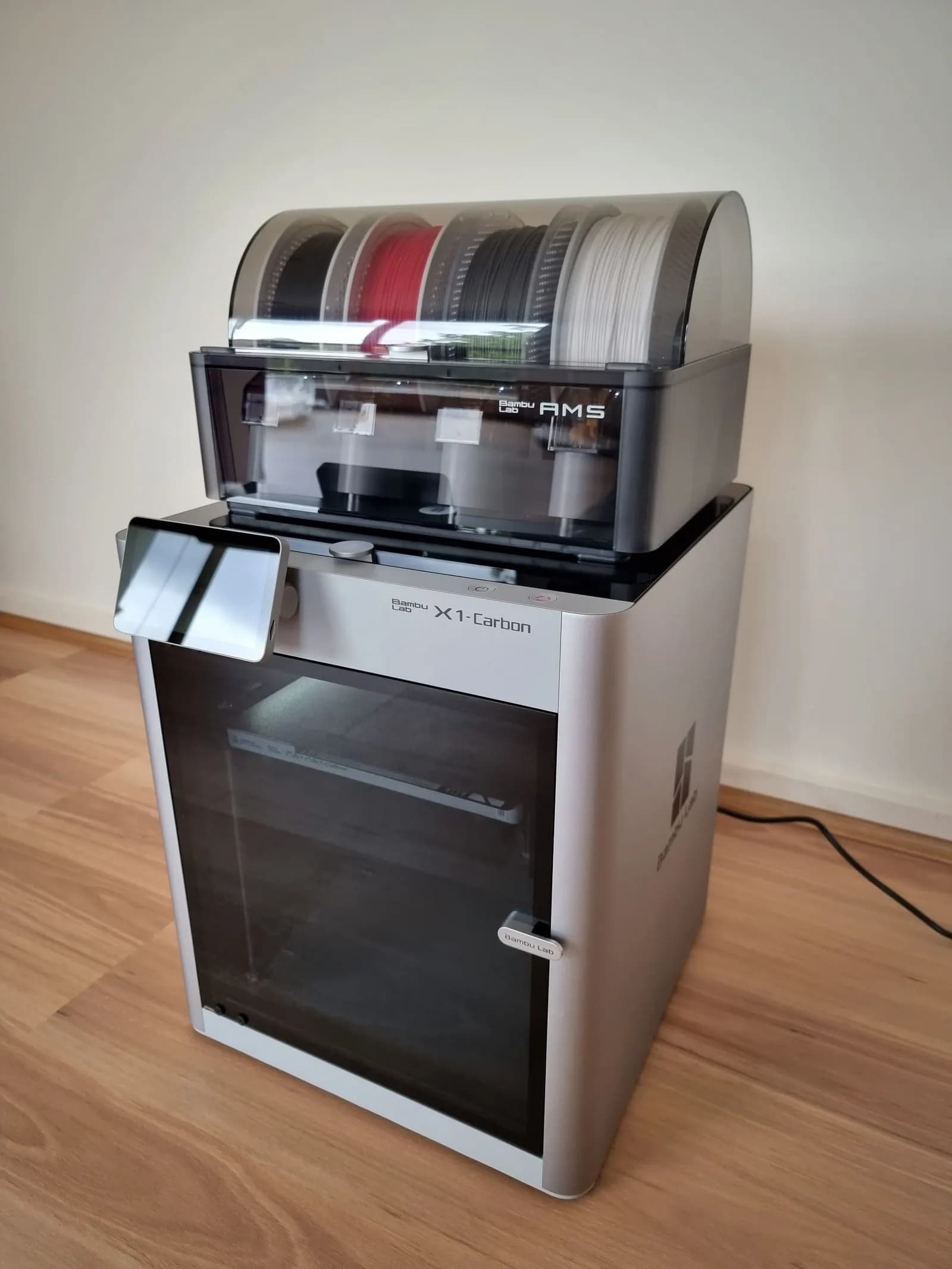
Bambu Lab X1-Carbon Fused Deposition (FDM) 3D Printer
Fast, enclosed, multi-material fabrication of functional parts from engineering thermoplastics and carbon- or glass-fibre-reinforced filaments.
In short
Fast, enclosed, multi-material fabrication of functional parts from engineering thermoplastics and carbon- or glass-fibre-reinforced filaments. The Bambu Lab X1-Carbon is an enclosed fused deposition (FDM) 3D printer with a CoreXY motion system, hardened-steel extruder gears and nozzle, a hotend rated to 300 °C and a heated build plate.
- Print technology
- Fused deposition (FDM), CoreXY
- Build volume
- 256 × 256 × 256 mm
- Maximum hotend temperature
- 300 °C
Services on this instrument
Rapid Prototyping: 3D Printing and CNC
from €3707–15 business daysRequest this serviceService details
Overview
The Bambu Lab X1-Carbon is an enclosed fused deposition (FDM) 3D printer with a CoreXY motion system, hardened-steel extruder gears and nozzle, a hotend rated to 300 °C and a heated build plate. The enclosed, heat-retaining chamber allows stable processing of warp-prone engineering thermoplastics such as ABS, ASA, polycarbonate and nylon, as well as carbon- and glass-fibre-reinforced composite filaments. Lidar-based first-layer inspection and vibration compensation improve print quality automatically, while the optional automatic material system (AMS) enables multi-colour and multi-material printing and the use of soluble supports. Test specimens, instrument accessories, sample holders, enclosures and functional prototypes are produced quickly and repeatably; the printer also serves as an experimental platform for filament development and composite materials research.
Measurement principle
Capabilities
Carbon- and glass-fibre-reinforced filament printing with a hardened-steel nozzle
Engineering plastics such as PC, PA and ASA with a 300 °C hotend and heated chamber
Multi-colour / multi-material printing and soluble supports via AMS
Lidar first-layer inspection and automatic vibration compensation
Production of tensile and impact test specimens to ASTM/ISO geometries
Rapid fabrication of laboratory fixtures, enclosures and sample holders
Suitable samples
PLA, PETG and ABS/ASA filaments
Polycarbonate and nylon (PA) filaments
Carbon- and glass-fibre-reinforced composite filaments
Flexible filaments such as TPU
Mechanical test specimens and functional prototypes
Technical specifications
| Print technology | Fused deposition (FDM), CoreXY |
|---|---|
| Build volume | 256 × 256 × 256 mm |
| Maximum hotend temperature | 300 °C |
| Nozzle | Hardened steel, 0.4 mm (0.2–0.8 mm options) |
| Enclosure | Enclosed heat-retaining chamber with activated-carbon filter |
| Multi-material | Up to 4 spools via AMS |
| Quality control | Lidar first-layer inspection, vibration compensation, camera monitoring |
Services on this instrument
Rapid Prototyping: 3D Printing and CNC
from €3707–15 business daysRequest this serviceService details
- Manufacturer
- Bambu Lab
- Model
- X1-Carbon
- Catalogue no.
- 28
- Reference standards
- ISO/ASTM 52900
Quick answers
FDM 3D Printer: key facts
What is Bambu Lab X1-Carbon Fused Deposition (FDM) 3D Printer used for?
It is used for: Carbon- and glass-fibre-reinforced filament printing with a hardened-steel nozzle, Engineering plastics such as PC, PA and ASA with a 300 °C hotend and heated chamber, Multi-colour / multi-material printing and soluble supports via AMS, Lidar first-layer inspection and automatic vibration compensation, Production of tensile and impact test specimens to ASTM/ISO geometries, and Rapid fabrication of laboratory fixtures, enclosures and sample holders.
Which samples can Bambu Lab X1-Carbon Fused Deposition (FDM) 3D Printer analyse?
Suitable samples: PLA, PETG and ABS/ASA filaments, Polycarbonate and nylon (PA) filaments, Carbon- and glass-fibre-reinforced composite filaments, Flexible filaments such as TPU, and Mechanical test specimens and functional prototypes.
Which standards does Bambu Lab X1-Carbon Fused Deposition (FDM) 3D Printer relate to?
Relevant standards: ISO/ASTM 52900.
Which NAKTEM services use Bambu Lab X1-Carbon Fused Deposition (FDM) 3D Printer?
Rapid Prototyping: 3D Printing and CNC.
What results do I receive?
Typical deliverables: Fabricated parts (resin, FDM or CNC) with the requested post-processing, Production record covering material, layer height/toolpath, print or machining parameters and post-processing steps, Manufacturability assessment and design improvement suggestions, Dimensional check report of critical features by calliper/micrometer on request, and Production summary report (PDF).
Related services
Sample preparation and processing
Rapid Prototyping: 3D Printing and CNC
Resin (SLA/LFS) and FDM 3D printing together with desktop CNC machining for test specimens, fixtures, sample holders and functional prototypes.
Related instruments
Additive manufacturing and prototyping
Formlabs Form 4B Resin 3D Printer (MSLA)
High-resolution layer-by-layer fabrication of functional prototypes, moulds and biocompatible parts from photocurable resins with fine surface finish.
Additive manufacturing and prototyping
Makera Carvera Air CA1 Desktop CNC Mill (4th Axis and Laser Module)
Precision subtractive machining of aluminium, brass, polymers and PCBs, with rotary machining on the 4th axis and laser marking and cutting.
Synthesis and processing
Areka MCX-25/50D Twin-Screw Extruder and Compounding Line
Laboratory-scale co-rotating twin-screw extruder for polymer compounding, filler and additive dispersion, and reactive extrusion.
Request analysis on this instrument
Tell us about your sample and the question. Our scientists confirm feasibility and propose a measurement plan.