
Testing
Salt Spray Testing: What the Hours Really Mean
"500 hours of salt spray" does not mean a product will last five years. We explain what ISO 9227 and ASTM B117 tests actually measure, what they do not, and how to write a test specification that produces a meaningful answer.
Published October 13, 2026
5 min read
NAKTEM Editorial Team
Last updated:
What a neutral salt spray test actually does
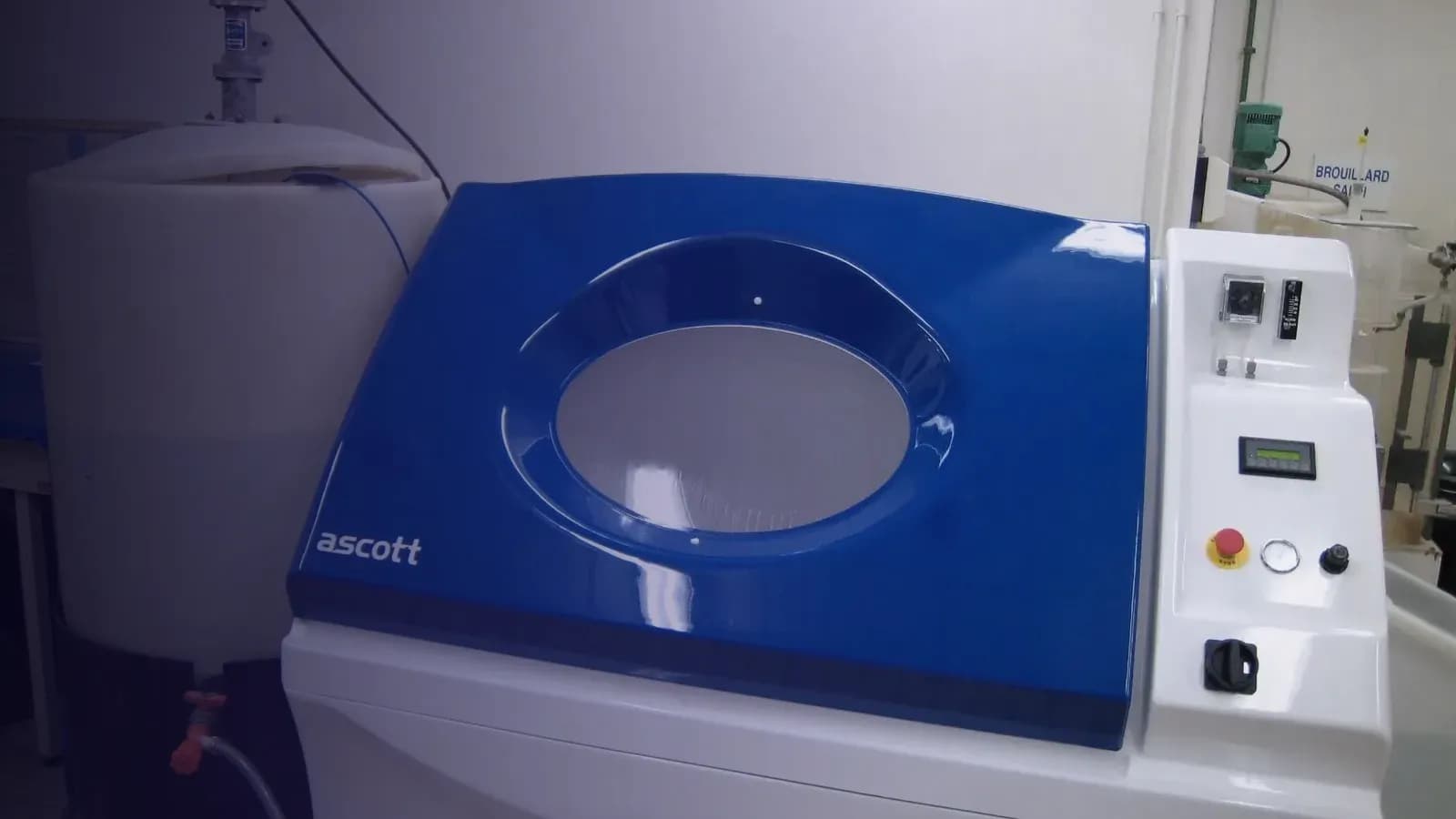
The neutral salt spray (NSS) test is defined in ISO 9227 and ASTM B117. Specimens are exposed in a closed cabinet to an atmosphere created by continuously atomising a 5 % by mass sodium chloride solution at 35 °C. The pH of the solution is kept between 6.5 and 7.2, specimens are positioned at 15–30° from the vertical, and the fog density is verified with collection vessels at 1–2 mL per 80 cm² per hour. The test runs without interruption for a predetermined duration.
These conditions do not imitate a real marine or urban atmosphere. They constitute a deliberately artificial and highly aggressive environment designed to accelerate corrosion. Continuous wetness, the absence of a drying cycle and the high chloride load produce a corrosion mechanism that differs fundamentally from most real-world exposures. The value of the test lies not in its realism but in its repeatability and in the fact that it is applied in the same way worldwide.
Why hours are not a service-life prediction
ISO 9227 itself states clearly that no direct relationship can be established between test results and resistance in a real environment. Different coating systems respond differently to the salt spray atmosphere: zinc coatings cannot form the protective carbonate layer under continuous wetness and generate white rust far faster than they would in service, whereas some organic coatings perform well in the cabinet yet degrade early under real conditions involving ultraviolet light and thermal cycling.
A result such as "1000 hours" therefore does not say that a product will last a particular time; it says how the product performs relative to a reference or an acceptance criterion. The test can be used reliably for three purposes: ranking coating systems within the same material family, monitoring the stability of a production process (catching a drift in a phosphating bath early, for example) and verifying a minimum acceptance threshold defined in a specification.
Genuine service-life estimation requires cyclic corrosion tests (ISO 11997, ISO 16701 or the proprietary cycles of automotive manufacturers), field exposure and electrochemical methods evaluated together. Salt spray is the fastest and most standardised member of that toolset, but also the least realistic, and it should be presented to customers and auditors in exactly those terms.
NSS, AASS and CASS: three tests, three different questions
ISO 9227 defines three methods. Neutral salt spray (NSS) is the general-purpose test for metals, metallic coatings, conversion coatings and organic coatings. Acetic acid salt spray (AASS) acidifies the same solution with acetic acid to pH 3.1–3.3 and is used in particular for decorative copper-nickel-chromium coatings and anodised aluminium, where the neutral test is often too slow to discriminate between good and poor deposits.
Copper-accelerated acetic acid salt spray (CASS, also ASTM B368) adds copper(II) chloride to the solution and raises the cabinet temperature to 50 °C. It is the most aggressive variant and gives results far more quickly than NSS on decorative chromium coatings; 8 to 24 hours of CASS can yield information comparable to hundreds of hours of NSS. CASS results cannot, however, be converted to NSS hours by a simple factor; each method must be specified together with its own acceptance criteria.
How results are evaluated
The output of a salt spray test is not a single number but a series of visual evaluations made at defined intervals. For metallic coatings the ISO 10289 protection and appearance rating is used; rusting of the steel (red rust) and corrosion of the zinc (white rust) are recorded separately, together with the hour at which each first appeared. For organic coatings the ISO 4628 series applies: blistering (4628-2), rusting (4628-3) and corrosion or delamination spreading from a scribe (4628-8) are each rated independently.
On painted specimens the scribe test is the most informative measurement. The coating is cut through to the metal in a controlled line, and at the end of the test the width of corrosion creeping sideways from the scribe is measured in millimetres. This value says far more about adhesion and the quality of substrate pretreatment than the surface appearance does. The inspection intervals (for example 24, 48, 96, 240 and 500 hours) should be agreed before the test starts and documented with photographs.
Regions where the coating is inherently weak, such as specimen edges and holes, are excluded from evaluation unless the specification says otherwise and are usually masked with tape or wax. The number of replicate specimens tested and the way their results are combined (worst specimen or average) must be stated explicitly in the report, since a single failing panel among three carries a different meaning from a uniform failure.
How to write a meaningful test specification
A good specification starts with "500 hours NSS" but does not end there. The method and standard edition (ISO 9227 NSS or ASTM B117), the duration, the intermediate inspection hours, the rating standard to be applied and the acceptance criterion for each (for example "no red rust at 240 hours, scribe creep no more than 2 mm at 500 hours") should all be defined explicitly. Whether a scribe is made, whether edges are masked, the number of specimens and the cleaning procedure before testing should also be stated.
Coating thickness must be known in order to interpret a salt spray result; within the same coating system, the difference between 8 µm and 12 µm of zinc can change the outcome completely. The thickness of every specimen should therefore be measured by the magnetic or eddy-current method (ISO 2178 / ISO 2360) before the test and included in the report. Without it, there is no way to tell whether a poor result stems from the coating chemistry or simply from insufficient thickness.
NAKTEM plans salt spray tests together with coating thickness measurement and, where appropriate, electrochemical corrosion analysis. The customer thereby receives an answer not only to "how many hours did it survive" but also to "why did it survive that long", which is a far more useful basis for process improvement and supplier evaluation. Every report documents the method, the inspection intervals, the rating standards and the photographs taken at each interval.
NAKTEM Editorial Team
Technical Content TeamPrevious article
Author
- Technical Content Team
- NAKTEM Editorial Team
Related services
Testing
Salt Spray Corrosion Testing
Accelerated corrosion resistance evaluation of coatings, paints and metal surfaces by neutral salt spray testing according to ISO 9227 and ASTM B117.
Testing
Coating Thickness Testing
Non-destructive thickness measurement of paint, coatings and metallic layers on steel and non-ferrous substrates by magnetic and eddy-current methods.
Testing
Electrochemical Corrosion and Battery Testing
Potentiostat/galvanostat testing including polarisation, EIS, cyclic voltammetry and charge–discharge cycling for corrosion rate, coating and electrode evaluation.
Related instruments
Corrosion and durability
ZL-6001 Salt Spray Corrosion Test Chamber
Neutral, acetic-acid and copper-accelerated salt spray testing to ISO 9227 and ASTM B117 for ranking the corrosion resistance of coatings and metallic surfaces.
Coating and thin film
DeFelsko PosiTector 6000 Coating Thickness Gauge
Non-destructive measurement of paint, plating and thin-film thickness on metal substrates by magnetic induction and eddy-current principles.
Electrochemistry and electrical
Corrtest CS310X Electrochemical Workstation (Potentiostat / Galvanostat)
Single-channel electrochemical workstation for voltammetry, polarisation and impedance spectroscopy (EIS) in corrosion, battery and electrocatalysis studies.
Further reading
Characterization
FTIR or Raman: Which Technique Fits Your Sample?
FTIR and Raman probe the same molecular vibrations by different physics. A practical guide to choosing between them, what each needs from your sample, and how to read the resulting spectrum.
November 9, 20267 min readCharacterization
qPCR You Can Trust: Samples, Controls and Shipping
A trustworthy qPCR result is decided long before anything is pipetted into a plate. A practical, MIQE-aligned guide to sample integrity, controls, replicates and what to send to the laboratory.
November 9, 20267 min readCharacterization
BET Surface Area and Porosity: Degassing and Reading Isotherms
The reliability of a BET result is decided before the sample reaches the instrument. A practical guide to degassing, sample amount, isotherm types and the mistakes that most often spoil a measurement.
November 9, 20266 min read
Request this service
Describe your sample and the decision it supports. We reply with a technical proposal.