
Electrochemistry and electrical
Corrtest CS310X Electrochemical Workstation (Potentiostat / Galvanostat)
Single-channel electrochemical workstation for voltammetry, polarisation and impedance spectroscopy (EIS) in corrosion, battery and electrocatalysis studies.
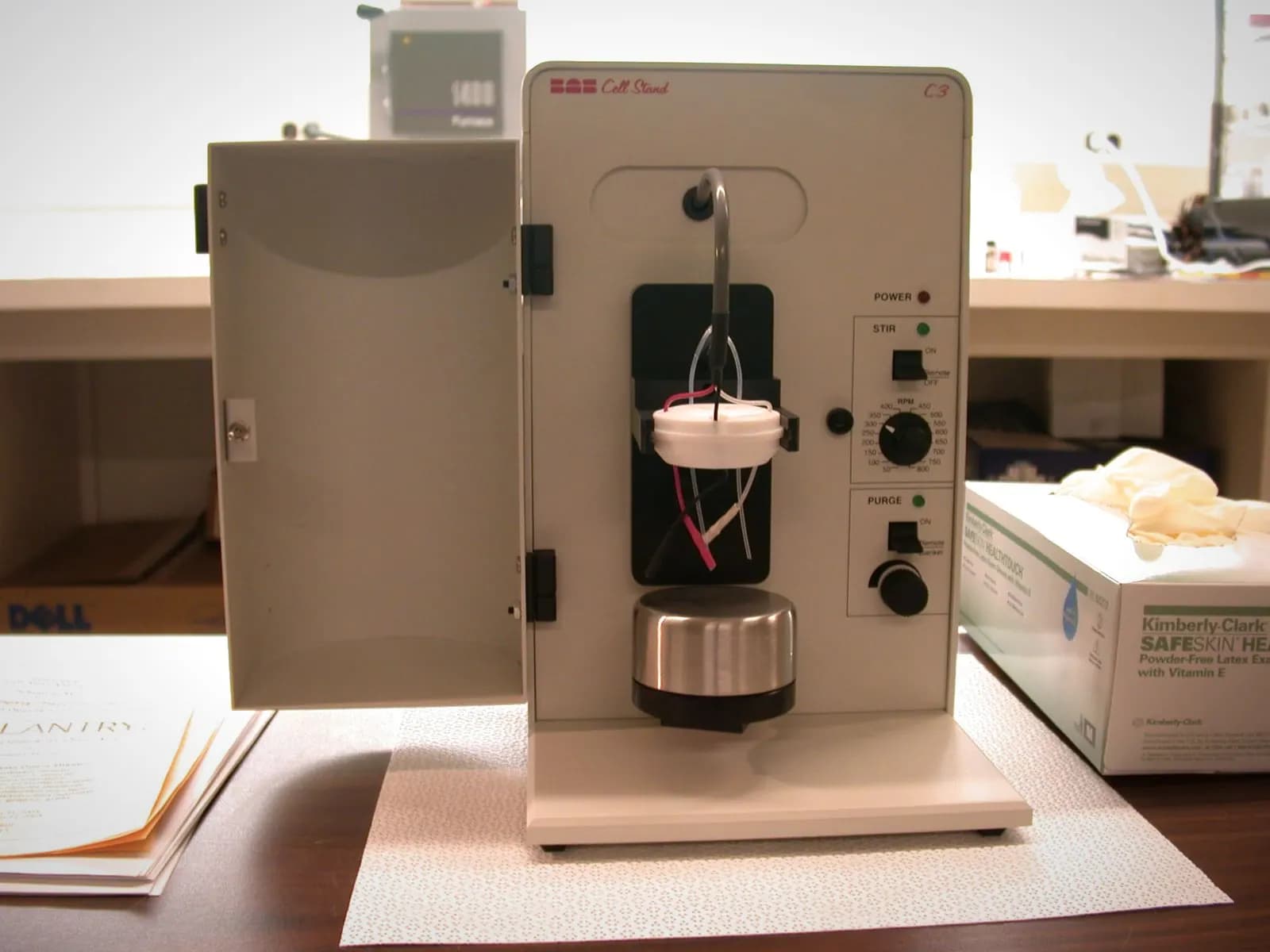
In short
Single-channel electrochemical workstation for voltammetry, polarisation and impedance spectroscopy (EIS) in corrosion, battery and electrocatalysis studies. The Corrtest CS310X is a single-channel potentiostat / galvanostat supporting three- and four-electrode cell configurations, with an integrated frequency response analyser for electrochemical impedance spectroscopy (EIS).
- Channels
- 1 (3- / 4-electrode)
- Potential range
- ±10 V
- Maximum current
- ±2 A
Services on this instrument
Electrochemical Corrosion and Battery Testing
from €1455–10 business daysRequest this serviceService detailsInstrument Operator Training
from €42014–30 business daysRequest this serviceService details
Overview
The Corrtest CS310X is a single-channel potentiostat / galvanostat supporting three- and four-electrode cell configurations, with an integrated frequency response analyser for electrochemical impedance spectroscopy (EIS). Cyclic, linear-sweep, differential-pulse and square-wave voltammetry; potentiodynamic and potentiostatic polarisation; corrosion-rate determination by Tafel extrapolation and linear polarisation resistance (LPR); chronoamperometry, chronopotentiometry and galvanostatic charge–discharge are run from the standard software. Typical applications include corrosion behaviour of metals and alloys, coating and inhibitor performance, battery and supercapacitor electrodes, fuel-cell catalysts and electrochemical sensors. Low current resolution and a wide impedance frequency range provide data quality suited to both academic research and industrial corrosion and energy-storage testing.
Measurement principle
Capabilities
Cyclic, linear-sweep, pulse and square-wave voltammetry
Potentiodynamic polarisation with Tafel and LPR corrosion-rate determination
Electrochemical impedance spectroscopy (EIS) with equivalent-circuit modelling
Chronoamperometry, chronopotentiometry and galvanostatic charge–discharge
Open-circuit potential monitoring and coating/inhibitor performance evaluation
Suitable samples
Metal and alloy corrosion coupons
Organic and metallic coated surfaces
Battery and supercapacitor electrodes
Electrocatalyst and fuel-cell materials
Electrochemical sensor electrodes
Technical specifications
| Channels | 1 (3- / 4-electrode) |
|---|---|
| Potential range | ±10 V |
| Maximum current | ±2 A |
| Current ranges | Auto-ranging from the nA level up to 2 A |
| EIS frequency range | 10 µHz – 1 MHz |
| Core techniques | CV, LSV, DPV, SWV, Tafel, LPR, EIS, CA, CP |
Services on this instrument
Electrochemical Corrosion and Battery Testing
from €1455–10 business daysRequest this serviceService detailsInstrument Operator Training
from €42014–30 business daysRequest this serviceService details
- Manufacturer
- Corrtest
- Model
- CS310X
- Catalogue no.
- 26
- Reference standards
- ASTM G5, ASTM G59, ASTM G102, ASTM G106, ISO 17475
Quick answers
Potentiostat: key facts
What is Corrtest CS310X Electrochemical Workstation (Potentiostat / Galvanostat) used for?
It is used for: Cyclic, linear-sweep, pulse and square-wave voltammetry, Potentiodynamic polarisation with Tafel and LPR corrosion-rate determination, Electrochemical impedance spectroscopy (EIS) with equivalent-circuit modelling, Chronoamperometry, chronopotentiometry and galvanostatic charge–discharge, and Open-circuit potential monitoring and coating/inhibitor performance evaluation.
Which samples can Corrtest CS310X Electrochemical Workstation (Potentiostat / Galvanostat) analyse?
Suitable samples: Metal and alloy corrosion coupons, Organic and metallic coated surfaces, Battery and supercapacitor electrodes, Electrocatalyst and fuel-cell materials, and Electrochemical sensor electrodes.
Which standards does Corrtest CS310X Electrochemical Workstation (Potentiostat / Galvanostat) relate to?
Relevant standards: ASTM G5, ASTM G59, ASTM G102, ASTM G106, and ISO 17475.
Which NAKTEM services use Corrtest CS310X Electrochemical Workstation (Potentiostat / Galvanostat)?
Electrochemical Corrosion and Battery Testing and Instrument Operator Training.
What results do I receive?
Typical deliverables: OCP, Tafel and LPR plots with tables of Ecorr, icorr, corrosion rate (mm/year) and polarisation resistance, EIS Nyquist/Bode plots and equivalent circuit fitting parameters, CV, charge–discharge curves, specific capacity, coulombic efficiency and cycling stability plots (battery tests), Method summary covering electrolyte, cell configuration, scan rate and test temperature, and Raw data (CSV/TXT) and PDF report.
Related services
Testing
Electrochemical Corrosion and Battery Testing
Potentiostat/galvanostat testing including polarisation, EIS, cyclic voltammetry and charge–discharge cycling for corrosion rate, coating and electrode evaluation.
Training
Instrument Operator Training
Hands-on operator training on analytical instruments including SEM/EDS, XRD, Raman and rheometry, covering sample preparation, measurement and data interpretation.
Related instruments
Electrochemistry and electrical
Metrohm Multi Autolab M204 Multichannel Potentiostat / Galvanostat
Modular multichannel system for simultaneous, independent testing of several cells in battery, supercapacitor, corrosion and electrocatalysis experiments.
Corrosion and durability
ZL-6001 Salt Spray Corrosion Test Chamber
Neutral, acetic-acid and copper-accelerated salt spray testing to ISO 9227 and ASTM B117 for ranking the corrosion resistance of coatings and metallic surfaces.
Microscopy and imaging
ZEISS EVO 10 Scanning Electron Microscope with Oxford EDS Detector
Nanometre-scale surface morphology imaging with simultaneous elemental mapping by energy-dispersive X-ray spectroscopy.
Electrochemistry and electrical
Ossila P2010A2 Four-Point Probe Sheet Resistance Measurement System
Contact-resistance-independent measurement of sheet resistance, resistivity and conductivity of thin films, coatings and semiconductor wafers.
Further reading
Testing
Salt Spray Testing: What the Hours Really Mean
"500 hours of salt spray" does not mean a product will last five years. We explain what ISO 9227 and ASTM B117 tests actually measure, what they do not, and how to write a test specification that produces a meaningful answer.
October 13, 20265 min read
Request analysis on this instrument
Tell us about your sample and the question. Our scientists confirm feasibility and propose a measurement plan.