Particle and surface characterization
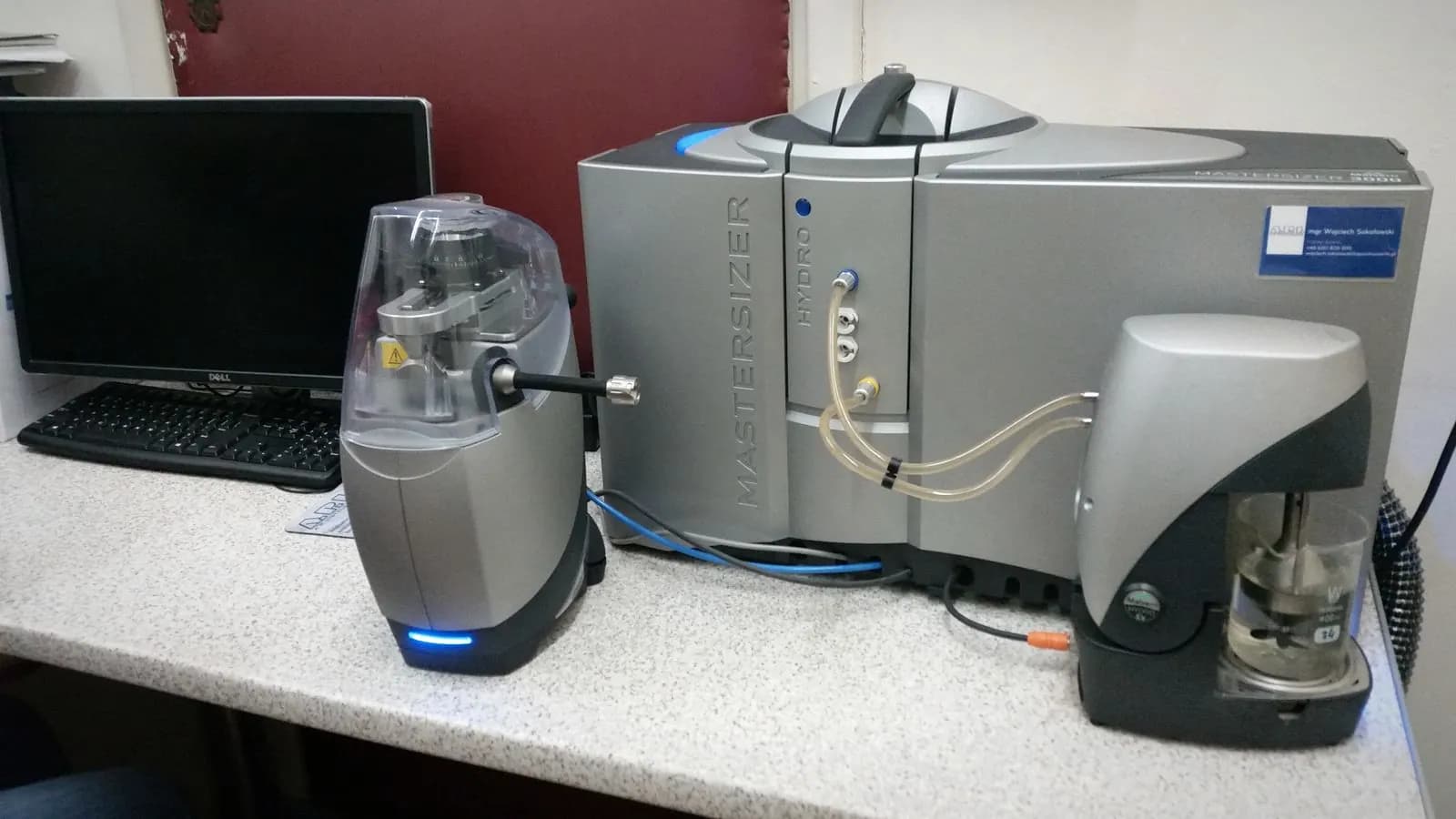
HORIBA Partica LA-960V2 Laser Diffraction Particle Size Analyser
Laser diffraction particle size distribution from 10 nm to 5 mm in wet or dry dispersion, supporting powder specification, formulation and quality control.
In short
Laser diffraction particle size distribution from 10 nm to 5 mm in wet or dry dispersion, supporting powder specification, formulation and quality control. The HORIBA Partica LA-960V2 determines particle size distributions by laser diffraction, applying Mie and Fraunhofer theory to the angular scattering pattern produced by a red laser diode and a blue LED source.
- Measurement principle
- Laser diffraction (Mie / Fraunhofer)
- Measurement range
- 10 nm – 5,000 µm
- Light sources
- 650 nm red laser diode and 405 nm blue LED
Services on this instrument
Particle Size Distribution Analysis
from €2203–7 business daysRequest this serviceService detailsInstrument Operator Training
from €42014–30 business daysRequest this serviceService details
Overview
The HORIBA Partica LA-960V2 determines particle size distributions by laser diffraction, applying Mie and Fraunhofer theory to the angular scattering pattern produced by a red laser diode and a blue LED source. The dual-wavelength optics extend the measurable range from 10 nanometres to 5 millimetres in a single run. Samples are introduced as aqueous or solvent suspensions through the circulating wet cell with ultrasonic de-agglomeration, or as free-flowing powders through the dry feeder, so that both the primary particle and the agglomerate state can be characterised. Outputs include volume-weighted distributions, D10/D50/D90 percentiles, span and specific surface area estimates reported in line with ISO 13320. The instrument serves pharmaceutical, ceramic, cement, pigment, battery material and food applications in which particle size governs flow, packing, reactivity and dissolution behaviour.
Measurement principle
Capabilities
Particle size distribution from 10 nm to 5,000 µm in a single measurement
Wet measurement in water and organic solvents with ultrasonic dispersion
Dry dispersion measurement for free-flowing powders
Reporting of D10/D50/D90, mean size, span and specific surface area
Mie and Fraunhofer models for transparent and opaque particles
Method development with controlled dispersion and refractive index parameters
Suitable samples
Ceramic and metal powders
Pigments, fillers and mineral powders
Battery electrode and cathode materials
Pharmaceutical actives and excipients
Emulsions and suspensions
Food and agricultural powders
Technical specifications
| Measurement principle | Laser diffraction (Mie / Fraunhofer) |
|---|---|
| Measurement range | 10 nm – 5,000 µm |
| Light sources | 650 nm red laser diode and 405 nm blue LED |
| Dispersion modes | Wet (circulating cell with ultrasonics) and dry feeder |
| Measurement time | Approximately one minute per sample |
| Reported parameters | D10/D50/D90, mean, mode, span, specific surface area |
Services on this instrument
Particle Size Distribution Analysis
from €2203–7 business daysRequest this serviceService detailsInstrument Operator Training
from €42014–30 business daysRequest this serviceService details
- Manufacturer
- HORIBA
- Model
- Partica LA-960V2
- Catalogue no.
- 1
- Reference standards
- ISO 13320, ISO 14887
Quick answers
Particle Size: key facts
What is HORIBA Partica LA-960V2 Laser Diffraction Particle Size Analyser used for?
It is used for: Particle size distribution from 10 nm to 5,000 µm in a single measurement, Wet measurement in water and organic solvents with ultrasonic dispersion, Dry dispersion measurement for free-flowing powders, Reporting of D10/D50/D90, mean size, span and specific surface area, Mie and Fraunhofer models for transparent and opaque particles, and Method development with controlled dispersion and refractive index parameters.
Which samples can HORIBA Partica LA-960V2 Laser Diffraction Particle Size Analyser analyse?
Suitable samples: Ceramic and metal powders, Pigments, fillers and mineral powders, Battery electrode and cathode materials, Pharmaceutical actives and excipients, Emulsions and suspensions, and Food and agricultural powders.
Which standards does HORIBA Partica LA-960V2 Laser Diffraction Particle Size Analyser relate to?
Relevant standards: ISO 13320 and ISO 14887.
Which NAKTEM services use HORIBA Partica LA-960V2 Laser Diffraction Particle Size Analyser?
Particle Size Distribution Analysis and Instrument Operator Training.
What results do I receive?
Typical deliverables: Volume-based size distribution chart and table (D10, D50, D90, mean diameters, span), Average of replicate measurements with repeatability assessment, Method summary covering dispersant, ultrasonic treatment and optical model parameters, Raw data export (CSV/Excel) and PDF report, and Statement of conformity to specification on request.
Related services
Analysis
Particle Size Distribution Analysis
Laser diffraction measurement of particle size distribution in powders, suspensions and emulsions from the nanometre to the millimetre range.
Training
Instrument Operator Training
Hands-on operator training on analytical instruments including SEM/EDS, XRD, Raman and rheometry, covering sample preparation, measurement and data interpretation.
Related instruments
Particle and surface characterization
MicrotracBEL BELSORP MINI X Gas Adsorption (BET) Analyser with BELPREP VAC III Degassing Unit
Determination of BET specific surface area, pore volume and pore size distribution of powders and porous materials from gas adsorption isotherms.
Microscopy and imaging
ZEISS EVO 10 Scanning Electron Microscope with Oxford EDS Detector
Nanometre-scale surface morphology imaging with simultaneous elemental mapping by energy-dispersive X-ray spectroscopy.
Synthesis and processing
Changsha XQM-0.2A Planetary Ball Mill
Simultaneous wet or dry planetary milling in four jars for sub-micron size reduction, homogeneous blending and mechanochemical processing of powders and suspensions.
Synthesis and processing
Unopex B15 Laboratory Spray Dryer
Single-step conversion of solutions, suspensions and emulsions into free-flowing powders of controlled size and morphology, for microencapsulation and granulation.
Further reading
Characterization
How to Choose a Particle Size Analysis Method
A practical guide to choosing between laser diffraction, electron microscopy, dynamic light scattering and sieving, based on your sample, your size range and how the result will be used.
September 8, 20265 min read
Request analysis on this instrument
Tell us about your sample and the question. Our scientists confirm feasibility and propose a measurement plan.