
Thermal, mechanical and rheology
Anton Paar MCR 302e Modular Compact Rheometer
Precise rotational and oscillatory characterisation of viscosity and viscoelastic behaviour in liquids, gels, pastes and polymer melts.
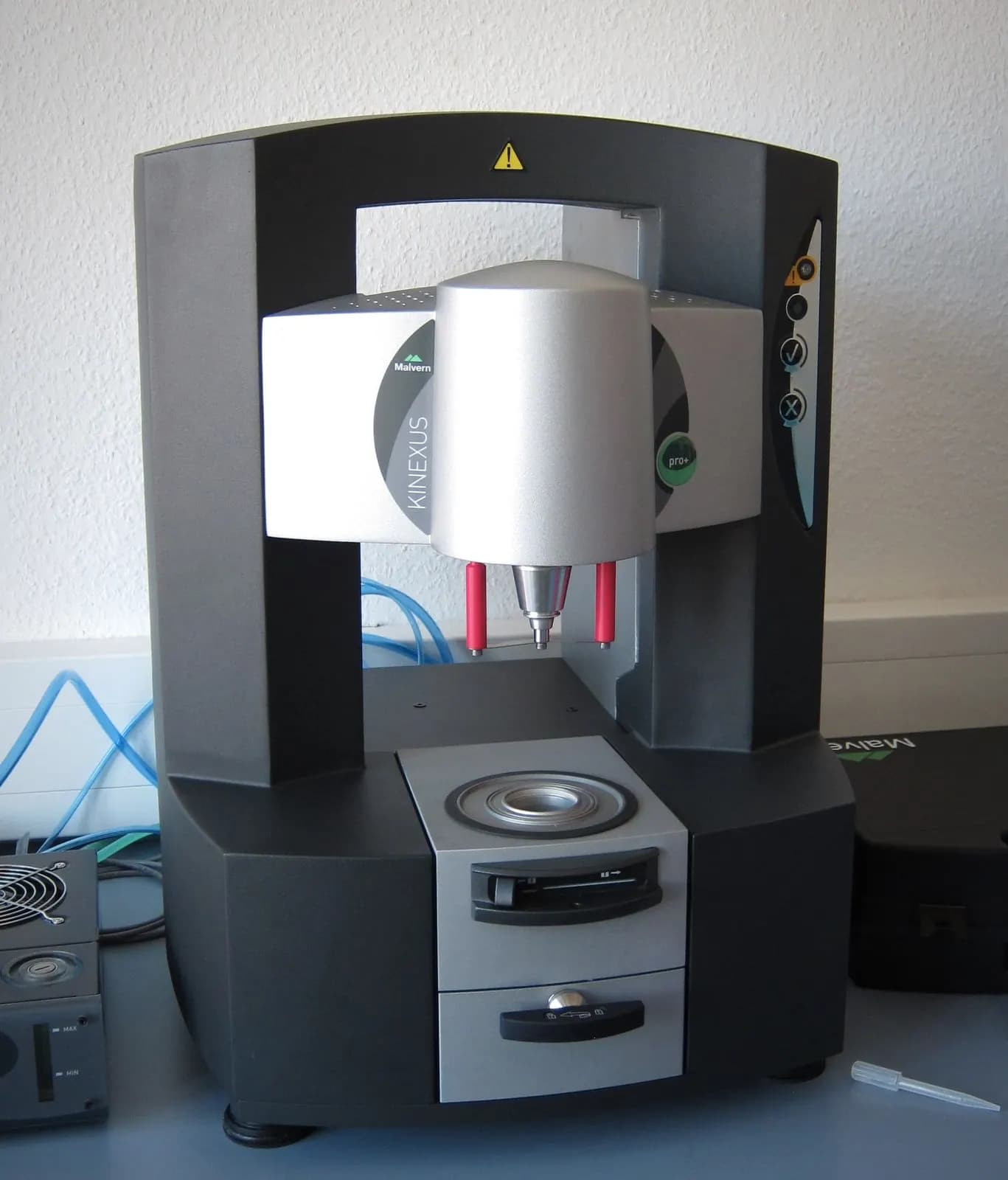
In short
Precise rotational and oscillatory characterisation of viscosity and viscoelastic behaviour in liquids, gels, pastes and polymer melts. The Anton Paar MCR 302e is a research-grade modular compact rheometer built around an air-bearing synchronous EC motor and true strain-controlled (CMT) measurement.
- Motor and bearing
- Air-bearing synchronous EC motor
- Torque range
- 1 nN·m – 230 mN·m
- Angular velocity
- 10⁻⁹ – 314 rad/s
Services on this instrument
Rheology and Viscosity Analysis
from €1753–7 business daysRequest this serviceService detailsInstrument Operator Training
from €42014–30 business daysRequest this serviceService details
Overview
The Anton Paar MCR 302e is a research-grade modular compact rheometer built around an air-bearing synchronous EC motor and true strain-controlled (CMT) measurement. In rotational mode it delivers flow curves, viscosity versus shear rate, yield stress and thixotropy; in oscillatory mode it resolves storage and loss moduli (G′, G″), amplitude and frequency sweeps, temperature ramps and gelation or curing kinetics. Cone-plate, parallel-plate and concentric-cylinder geometries combined with Peltier temperature control cover materials from low-viscosity solutions to high-viscosity polymer melts. The instrument provides repeatable rheological data for formulation development, process design and quality control in paints, coatings, cosmetics, food, cement, biomaterials and polymer composites.
Measurement principle
Capabilities
Rotational flow curves, viscosity and yield stress determination
Oscillatory G′/G″ measurement with amplitude and frequency sweeps
Peltier-controlled temperature ramps and isothermal curing or gelation monitoring
Thixotropy, creep and stress-relaxation testing
Cone-plate, parallel-plate and concentric-cylinder geometries from low to high viscosity
Normal force measurement for tracking structural changes
Suitable samples
Paints, coatings and inks
Polymer solutions and melts
Gels, creams and cosmetic formulations
Food and biopolymer systems
Cement pastes and ceramic slurries
Nanoparticle suspensions
Technical specifications
| Motor and bearing | Air-bearing synchronous EC motor |
|---|---|
| Torque range | 1 nN·m – 230 mN·m |
| Angular velocity | 10⁻⁹ – 314 rad/s |
| Oscillation frequency | 10⁻⁷ – 100 Hz |
| Normal force | 0.005 – 50 N |
| Measuring geometries | Cone-plate, parallel-plate, concentric cylinder |
| Temperature control | Peltier plate system |
Services on this instrument
Rheology and Viscosity Analysis
from €1753–7 business daysRequest this serviceService detailsInstrument Operator Training
from €42014–30 business daysRequest this serviceService details
- Manufacturer
- Anton Paar
- Model
- MCR 302e
- Catalogue no.
- 24
- Reference standards
- ISO 3219, ISO 6721-10, ASTM D4440
Quick answers
Rheometer: key facts
What is Anton Paar MCR 302e Modular Compact Rheometer used for?
It is used for: Rotational flow curves, viscosity and yield stress determination, Oscillatory G′/G″ measurement with amplitude and frequency sweeps, Peltier-controlled temperature ramps and isothermal curing or gelation monitoring, Thixotropy, creep and stress-relaxation testing, Cone-plate, parallel-plate and concentric-cylinder geometries from low to high viscosity, and Normal force measurement for tracking structural changes.
Which samples can Anton Paar MCR 302e Modular Compact Rheometer analyse?
Suitable samples: Paints, coatings and inks, Polymer solutions and melts, Gels, creams and cosmetic formulations, Food and biopolymer systems, Cement pastes and ceramic slurries, and Nanoparticle suspensions.
Which standards does Anton Paar MCR 302e Modular Compact Rheometer relate to?
Relevant standards: ISO 3219, ISO 6721-10, and ASTM D4440.
Which NAKTEM services use Anton Paar MCR 302e Modular Compact Rheometer?
Rheology and Viscosity Analysis and Instrument Operator Training.
What results do I receive?
Typical deliverables: Flow curves (viscosity vs. shear rate) and viscosity table at selected shear rates, Amplitude and frequency sweeps: G′, G″, tan δ and linear viscoelastic limit, Yield stress, thixotropy (three-interval thixotropy test) and temperature sweep results (on request), Method summary covering geometry, gap, temperature and pre-shear conditions, and Raw data (CSV/Excel) and PDF report.
Related services
Analysis
Rheology and Viscosity Analysis
Rotational and oscillatory rheometry to determine flow curves, viscoelastic moduli, yield stress and thixotropy of liquids, gels, pastes and polymer melts.
Training
Instrument Operator Training
Hands-on operator training on analytical instruments including SEM/EDS, XRD, Raman and rheometry, covering sample preparation, measurement and data interpretation.
Related instruments
Synthesis and processing
Areka MCX-25/50D Twin-Screw Extruder and Compounding Line
Laboratory-scale co-rotating twin-screw extruder for polymer compounding, filler and additive dispersion, and reactive extrusion.
Particle and surface characterization
HORIBA Partica LA-960V2 Laser Diffraction Particle Size Analyser
Laser diffraction particle size distribution from 10 nm to 5 mm in wet or dry dispersion, supporting powder specification, formulation and quality control.
Spectroscopy and diffraction
Anton Paar Lyza 7000 Fourier Transform Infrared Spectrometer (FTIR)
Functional group identification, material verification and quality control of solids, liquids and films in ATR and transmission sampling modes.
Further reading
Training
Why Materials Characterization Training Pays Off
A badly prepared sample, a wrongly chosen parameter or an over-interpreted spectrum can cost far more than the instrument itself. We explain why structured characterization training delivers a tangible return for R&D and quality teams.
October 27, 20264 min readIndustry
Rheology for Coatings and Inks: A Practical Primer
A single viscosity number cannot tell you whether a paint will sag, whether an ink will transfer cleanly or whether pigment will settle in storage. We explain how shear rate, thixotropy, yield stress and oscillatory tests translate into formulation decisions.
October 20, 20265 min read
Request analysis on this instrument
Tell us about your sample and the question. Our scientists confirm feasibility and propose a measurement plan.