Spectroscopy and diffraction
Olympus BX43F-based Confocal Micro-Raman Spectroscopy System
Laser-excited micro-Raman spectroscopy for chemical and structural identification at micrometre resolution, including phase and defect analysis of carbon materials.
In short
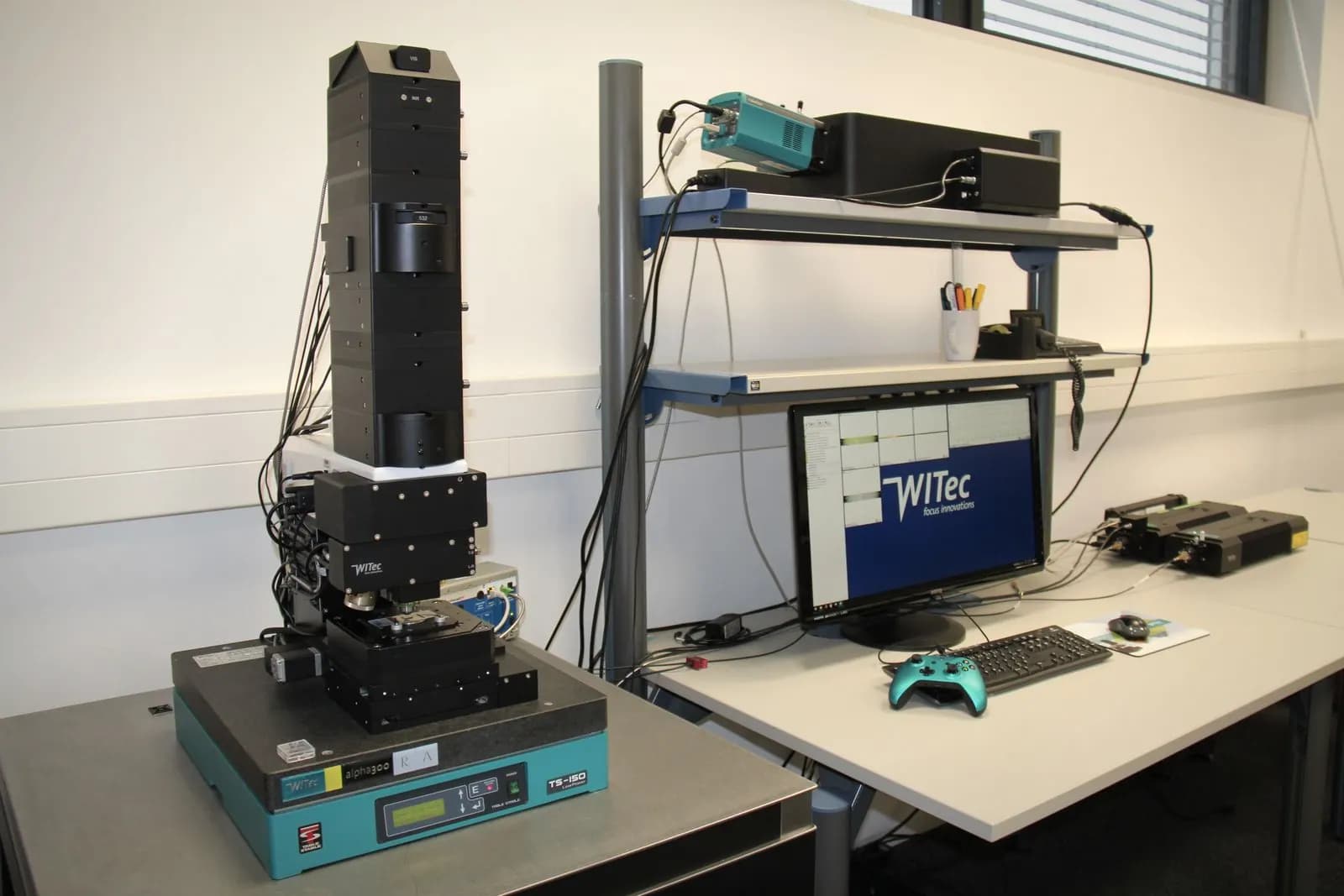
Laser-excited micro-Raman spectroscopy for chemical and structural identification at micrometre resolution, including phase and defect analysis of carbon materials. The system comprises a Raman spectrometer coupled to an Olympus BX43F upright research microscope frame; a focused laser excites the specimen and the inelastically scattered light is collected to produce a vibrational spectrum.
- Microscope frame
- Olympus BX43F upright research microscope
- Excitation
- Visible-range laser excitation
- Measurement modes
- Point spectrum, line scan, area mapping, depth profile
Services on this instrument
Raman Spectroscopy Analysis
from €2103–7 business daysRequest this serviceService detailsInstrument Operator Training
from €42014–30 business daysRequest this serviceService details
Overview
The system comprises a Raman spectrometer coupled to an Olympus BX43F upright research microscope frame; a focused laser excites the specimen and the inelastically scattered light is collected to produce a vibrational spectrum. Because Raman shifts respond directly to molecular bonding, crystalline phase, strain and defect density, the technique delivers non-destructive chemical identification with essentially no sample preparation. The microscope objectives enable point analysis, line scans and Raman mapping at sub-micrometre lateral resolution, while confocal optics provide depth discrimination in thin films and layered structures. Principal applications include D/G/2D band analysis of graphene and carbon nanotubes, crystallinity and component identification in polymers, phase discrimination in minerals and polymorph determination in pharmaceuticals. Results are reported as spectral library matches, peak parameters and chemical maps.
Measurement principle
Capabilities
Raman mapping by point, line and area scanning
D/G/2D band and defect analysis of graphene, CNTs and carbon materials
Crystallinity, orientation and component identification in polymers
Phase discrimination and polymorph determination in minerals and ceramics
Confocal depth profiling of layered structures
Spectral library matching and peak parameter reporting
Suitable samples
Graphene, carbon nanotubes and carbon powders
Polymer films, fibres and composites
Mineral, ceramic and glass specimens
Thin films and coatings
Pharmaceutical solid forms
Semiconductor and 2D materials
Technical specifications
| Microscope frame | Olympus BX43F upright research microscope |
|---|---|
| Excitation | Visible-range laser excitation |
| Measurement modes | Point spectrum, line scan, area mapping, depth profile |
| Lateral resolution | Sub-micrometre with high-magnification objectives |
| Sample preparation | None required; non-destructive, non-contact measurement |
| Data output | Spectra, peak tables, maps, library matches |
Services on this instrument
Raman Spectroscopy Analysis
from €2103–7 business daysRequest this serviceService detailsInstrument Operator Training
from €42014–30 business daysRequest this serviceService details
- Manufacturer
- Olympus
- Model
- BX43F
- Catalogue no.
- 2
- Reference standards
- ASTM E1840, ASTM E2529
Quick answers
Raman: key facts
What is Olympus BX43F-based Confocal Micro-Raman Spectroscopy System used for?
It is used for: Raman mapping by point, line and area scanning, D/G/2D band and defect analysis of graphene, CNTs and carbon materials, Crystallinity, orientation and component identification in polymers, Phase discrimination and polymorph determination in minerals and ceramics, Confocal depth profiling of layered structures, and Spectral library matching and peak parameter reporting.
Which samples can Olympus BX43F-based Confocal Micro-Raman Spectroscopy System analyse?
Suitable samples: Graphene, carbon nanotubes and carbon powders, Polymer films, fibres and composites, Mineral, ceramic and glass specimens, Thin films and coatings, Pharmaceutical solid forms, and Semiconductor and 2D materials.
Which standards does Olympus BX43F-based Confocal Micro-Raman Spectroscopy System relate to?
Relevant standards: ASTM E1840 and ASTM E2529.
Which NAKTEM services use Olympus BX43F-based Confocal Micro-Raman Spectroscopy System?
Raman Spectroscopy Analysis and Instrument Operator Training.
What results do I receive?
Typical deliverables: Baseline-corrected Raman spectra with peak position and width tables, D/G and 2D/G ratio evaluation for carbon materials, Optical micrographs documenting the measured spots, Method summary covering laser wavelength, power, exposure and objective, and Raw spectral data (CSV/TXT) and PDF report.
Related services
Analysis
Raman Spectroscopy Analysis
Non-destructive micro-Raman spectroscopy for molecular structure, phase identification, crystallinity and defect analysis of carbon and other materials.
Training
Instrument Operator Training
Hands-on operator training on analytical instruments including SEM/EDS, XRD, Raman and rheometry, covering sample preparation, measurement and data interpretation.
Related instruments
Spectroscopy and diffraction
Anton Paar Lyza 7000 Fourier Transform Infrared Spectrometer (FTIR)
Functional group identification, material verification and quality control of solids, liquids and films in ATR and transmission sampling modes.
Spectroscopy and diffraction
Anton Paar XRDynamic 500 X-ray Diffractometer (XRD)
Crystalline phase identification, quantitative phase analysis, crystallite size and non-ambient structural studies on powders and solid materials.
Microscopy and imaging
ZEISS EVO 10 Scanning Electron Microscope with Oxford EDS Detector
Nanometre-scale surface morphology imaging with simultaneous elemental mapping by energy-dispersive X-ray spectroscopy.
Synthesis and processing
Chemical Vapour Deposition (CVD) Thin Film and Nanomaterial Synthesis System
Tube-furnace CVD synthesis of graphene, carbon nanotubes, transition metal dichalcogenides and oxide thin films under controlled gas flow and temperature profiles.
Further reading
Characterization
FTIR or Raman: Which Technique Fits Your Sample?
FTIR and Raman probe the same molecular vibrations by different physics. A practical guide to choosing between them, what each needs from your sample, and how to read the resulting spectrum.
November 9, 20267 min read
Request analysis on this instrument
Tell us about your sample and the question. Our scientists confirm feasibility and propose a measurement plan.