
Spectroscopy and diffraction
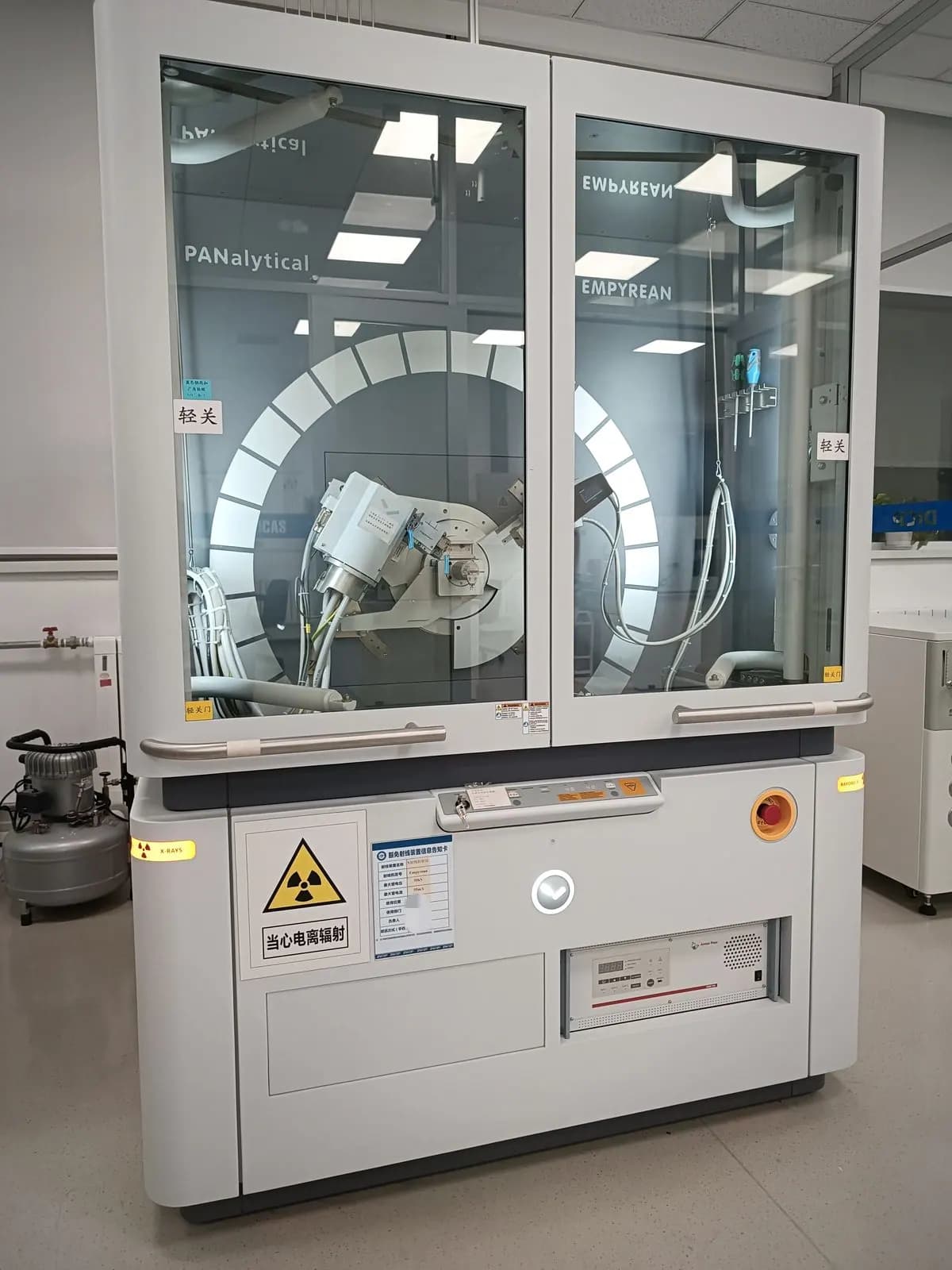
Anton Paar XRDynamic 500 X-ray Diffractometer (XRD)
Crystalline phase identification, quantitative phase analysis, crystallite size and non-ambient structural studies on powders and solid materials.
In short
Crystalline phase identification, quantitative phase analysis, crystallite size and non-ambient structural studies on powders and solid materials. The Anton Paar XRDynamic 500 is a multipurpose powder X-ray diffractometer with a fully automated goniometer and automatic recognition of optical components. It switches between Bragg-Brentano and parallel-beam geometries without manual realignment, and its adjustable goniometer radius lets resolution be balanced against intensity.
- Goniometer
- Fully automated, adjustable radius
- Measurement geometries
- Bragg-Brentano and parallel beam
- X-ray source
- Sealed tube, Cu anode
Services on this instrument
XRD Phase Analysis
from €1403–7 business daysRequest this serviceService detailsInstrument Operator Training
from €42014–30 business daysRequest this serviceService details
Overview
The Anton Paar XRDynamic 500 is a multipurpose powder X-ray diffractometer with a fully automated goniometer and automatic recognition of optical components. It switches between Bragg-Brentano and parallel-beam geometries without manual realignment, and its adjustable goniometer radius lets resolution be balanced against intensity. Diffraction patterns provide phase identification, quantitative phase analysis by Rietveld refinement, crystallite size and microstrain, degree of crystallinity, lattice parameters and preferred orientation. Non-ambient sample chambers enable in situ monitoring of phase transformations, thermal expansion and reaction kinetics under controlled temperature, atmosphere and humidity. The system characterises ceramics, cement, minerals, alloys, battery and catalyst materials, pharmaceutical polymorphs and thin films for quality control, raw-material verification and academic research.
Measurement principle
Capabilities
Crystalline phase identification by powder diffraction
Quantitative phase analysis by Rietveld refinement
Crystallite size and microstrain by Scherrer and Williamson-Hall methods
Degree of crystallinity and lattice parameter determination
In situ measurements under controlled temperature and atmosphere
Thin-film analysis in Bragg-Brentano and parallel-beam geometries
Suitable samples
Ceramic, cement and mineral powders
Metals and alloys
Battery and catalyst materials
Pharmaceutical actives and polymorphs
Nanomaterials and thin films
Polymers and semi-crystalline materials
Technical specifications
| Goniometer | Fully automated, adjustable radius |
|---|---|
| Measurement geometries | Bragg-Brentano and parallel beam |
| X-ray source | Sealed tube, Cu anode |
| Optical components | Automatically recognised, alignment-free exchange |
| Sample stages | Multi-sample changer and non-ambient chambers |
| Data evaluation | Phase search-match, Rietveld refinement |
Services on this instrument
XRD Phase Analysis
from €1403–7 business daysRequest this serviceService detailsInstrument Operator Training
from €42014–30 business daysRequest this serviceService details
- Manufacturer
- Anton Paar
- Model
- XRDynamic 500
- Catalogue no.
- 21
- Reference standards
- EN 13925-1, EN 13925-2, ASTM E915
Quick answers
XRD: key facts
What is Anton Paar XRDynamic 500 X-ray Diffractometer (XRD) used for?
It is used for: Crystalline phase identification by powder diffraction, Quantitative phase analysis by Rietveld refinement, Crystallite size and microstrain by Scherrer and Williamson-Hall methods, Degree of crystallinity and lattice parameter determination, In situ measurements under controlled temperature and atmosphere, and Thin-film analysis in Bragg-Brentano and parallel-beam geometries.
Which samples can Anton Paar XRDynamic 500 X-ray Diffractometer (XRD) analyse?
Suitable samples: Ceramic, cement and mineral powders, Metals and alloys, Battery and catalyst materials, Pharmaceutical actives and polymorphs, Nanomaterials and thin films, and Polymers and semi-crystalline materials.
Which standards does Anton Paar XRDynamic 500 X-ray Diffractometer (XRD) relate to?
Relevant standards: EN 13925-1, EN 13925-2, and ASTM E915.
Which NAKTEM services use Anton Paar XRDynamic 500 X-ray Diffractometer (XRD)?
XRD Phase Analysis and Instrument Operator Training.
What results do I receive?
Typical deliverables: Diffraction patterns (2θ–intensity) with phase matches marked and peak list, ICDD PDF card numbers for identified phases and quantitative phase fractions, Crystallite size, microstrain and percentage crystallinity (on request), Method summary covering radiation, optics, scan range and step time, and Raw data (XRDML/CSV) and PDF report.
Related services
Analysis
XRD Phase Analysis
X-ray diffraction for crystalline phase identification, quantitative phase analysis, crystallite size and degree of crystallinity in powders and solids.
Training
Instrument Operator Training
Hands-on operator training on analytical instruments including SEM/EDS, XRD, Raman and rheometry, covering sample preparation, measurement and data interpretation.
Related instruments
Spectroscopy and diffraction
Olympus BX43F-based Confocal Micro-Raman Spectroscopy System
Laser-excited micro-Raman spectroscopy for chemical and structural identification at micrometre resolution, including phase and defect analysis of carbon materials.
Spectroscopy and diffraction
Anton Paar Lyza 7000 Fourier Transform Infrared Spectrometer (FTIR)
Functional group identification, material verification and quality control of solids, liquids and films in ATR and transmission sampling modes.
Microscopy and imaging
ZEISS EVO 10 Scanning Electron Microscope with Oxford EDS Detector
Nanometre-scale surface morphology imaging with simultaneous elemental mapping by energy-dispersive X-ray spectroscopy.
Particle and surface characterization
MicrotracBEL BELSORP MINI X Gas Adsorption (BET) Analyser with BELPREP VAC III Degassing Unit
Determination of BET specific surface area, pore volume and pore size distribution of powders and porous materials from gas adsorption isotherms.
Further reading
Training
Why Materials Characterization Training Pays Off
A badly prepared sample, a wrongly chosen parameter or an over-interpreted spectrum can cost far more than the instrument itself. We explain why structured characterization training delivers a tangible return for R&D and quality teams.
October 27, 20264 min read
Request analysis on this instrument
Tell us about your sample and the question. Our scientists confirm feasibility and propose a measurement plan.