Separation and purification
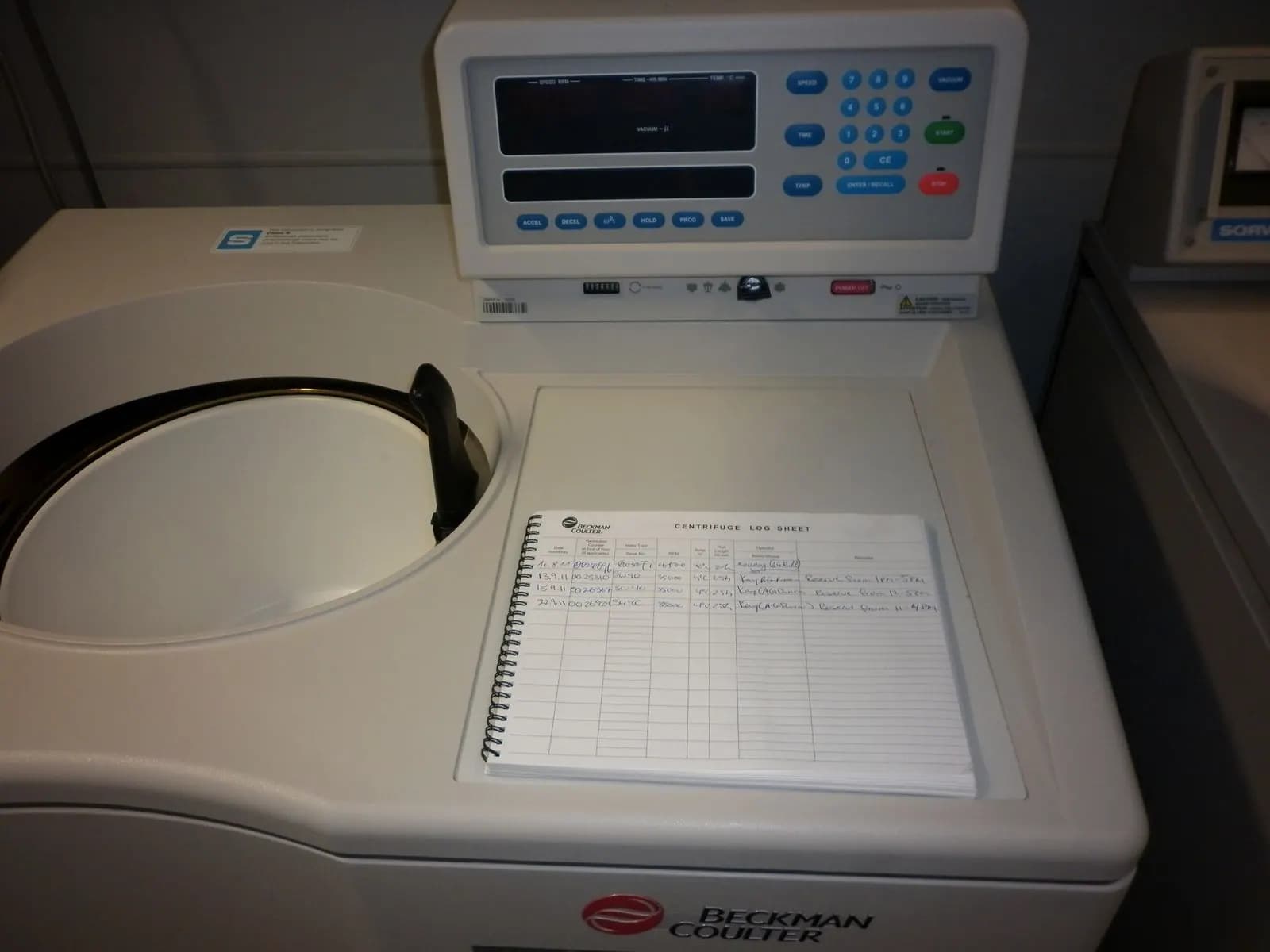
Beckman Coulter Optima XPN-100 Preparative Ultracentrifuge
Ultracentrifugation up to 100,000 rpm and 802,000 × g for separating, purifying and density-gradient fractionating nanoparticles, exosomes, viruses and macromolecules.
In short
Ultracentrifugation up to 100,000 rpm and 802,000 × g for separating, purifying and density-gradient fractionating nanoparticles, exosomes, viruses and macromolecules. The Beckman Coulter Optima XPN-100 is a floor-standing preparative ultracentrifuge whose vacuum-enclosed, frictionless induction-drive rotor system reaches 100,000 rpm and relative centrifugal forces of up to 802,000 × g.
- Maximum speed
- 100,000 rpm
- Maximum RCF
- 802,000 × g
- Temperature range
- 0 – 40 °C
Services on this instrument
Ultracentrifugation and Separation
from €7007–15 business daysRequest this serviceService details
Overview
The Beckman Coulter Optima XPN-100 is a floor-standing preparative ultracentrifuge whose vacuum-enclosed, frictionless induction-drive rotor system reaches 100,000 rpm and relative centrifugal forces of up to 802,000 × g. Fixed-angle, swinging-bucket and near-vertical rotors support both rate-zonal and isopycnic density-gradient separations, in which particles are fractionated by size and buoyant density in sucrose, iodixanol or CsCl gradients. Temperature is precisely controlled between 0 and 40 °C to protect heat-sensitive biological material. Typical applications include pelleting of metal oxide and polymer nanoparticles, size classification of carbon nanotube and graphene dispersions, isolation of exosomes and extracellular vesicles, purification of viruses and viral vectors, and preparation of liposomes and protein complexes. Programmable acceleration and deceleration profiles preserve gradient integrity, and every run is logged.
Measurement principle
Capabilities
High-speed sedimentation up to 100,000 rpm and 802,000 × g
Isopycnic and rate-zonal separation in sucrose, iodixanol and CsCl gradients
Size classification of nanoparticle, CNT and graphene dispersions
Purification of exosomes, extracellular vesicles and viruses
Processing of heat-sensitive samples under 0–40 °C temperature control
Programmable acceleration / deceleration profiles with run logging
Suitable samples
Nanoparticle suspensions
Carbon nanotube and graphene dispersions
Exosomes and extracellular vesicles
Viruses and viral vectors
Liposomes and lipid nanoparticles
Protein, nucleic acid and macromolecule solutions
Technical specifications
| Maximum speed | 100,000 rpm |
|---|---|
| Maximum RCF | 802,000 × g |
| Temperature range | 0 – 40 °C |
| Drive | Frictionless induction drive under vacuum |
| Rotor types | Fixed-angle, swinging-bucket, near-vertical |
| Programme control | Touch-screen interface, acceleration/deceleration profiles, run log |
Services on this instrument
Ultracentrifugation and Separation
from €7007–15 business daysRequest this serviceService details
- Manufacturer
- Beckman Coulter
- Model
- Optima XPN-100
- Catalogue no.
- 4
Quick answers
Ultracentrifuge: key facts
What is Beckman Coulter Optima XPN-100 Preparative Ultracentrifuge used for?
It is used for: High-speed sedimentation up to 100,000 rpm and 802,000 × g, Isopycnic and rate-zonal separation in sucrose, iodixanol and CsCl gradients, Size classification of nanoparticle, CNT and graphene dispersions, Purification of exosomes, extracellular vesicles and viruses, Processing of heat-sensitive samples under 0–40 °C temperature control, and Programmable acceleration / deceleration profiles with run logging.
Which samples can Beckman Coulter Optima XPN-100 Preparative Ultracentrifuge analyse?
Suitable samples: Nanoparticle suspensions, Carbon nanotube and graphene dispersions, Exosomes and extracellular vesicles, Viruses and viral vectors, Liposomes and lipid nanoparticles, and Protein, nucleic acid and macromolecule solutions.
Which NAKTEM services use Beckman Coulter Optima XPN-100 Preparative Ultracentrifuge?
Ultracentrifugation and Separation.
What results do I receive?
Typical deliverables: Separated and labelled fractions (pellet, supernatant or gradient bands), Process record covering rotor, speed (rpm/g), run time, temperature and gradient composition, Volume and mass balance with recovery notes, Post-separation particle size or concentration verification on request, and Process summary report (PDF).
Related services
Sample preparation and processing
Ultracentrifugation and Separation
High-speed ultracentrifugation to separate, purify and concentrate nanoparticles, exosomes, viruses, proteins and polymer fractions from suspensions.
Related instruments
Separation and purification
CRP-02A Cross-Flow (Tangential Flow) Membrane Filtration System
Fouling-resistant concentration, diafiltration and size-based fractionation of nanoparticle, protein and colloidal suspensions through MF and UF membranes.
Particle and surface characterization
HORIBA Partica LA-960V2 Laser Diffraction Particle Size Analyser
Laser diffraction particle size distribution from 10 nm to 5 mm in wet or dry dispersion, supporting powder specification, formulation and quality control.
Life science
Bio-Rad C1000 Touch Thermal Cycler with CFX96 Real-Time PCR (qPCR) Optical Module
Real-time quantitative PCR in a 96-well format with five-colour multiplex fluorescence detection for gene expression, pathogen detection and genotyping.
Request analysis on this instrument
Tell us about your sample and the question. Our scientists confirm feasibility and propose a measurement plan.